


Introduction
The name of this rock is ‘Mawson Charnockite’. The name honours the work of Sir Douglas Mawson, Australia’s most famous Antarctic explorer and a prominent geologist who contributed substantially to our understanding of the frozen continent. A charnockite is a type of rock which forms at considerable depth in the Earth’s crust (see Geological overview).
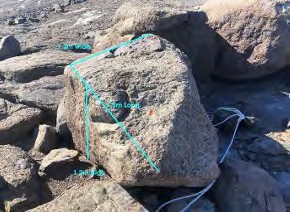
The NRG’s specimens were collected from a beach accumulation of rocks as shown in the figure above. This scene is at Mawson Station, one of Australia’s three research bases in Antarctica.
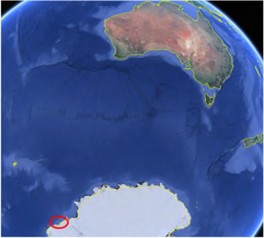
The location of Mawson Station (red circle) relative to the Australian mainland is shown in this image.
Geological overview
The name charnockite refers to a rock which is somewhat similar to a granite in that it is typically composed of quartz, K-feldspar, plagioclase and orthopyroxene. They are found in high temperature-high pressure areas of the Earth’s crust, where the metamorphic processes associated with heat and pressure are dominant. However, the real origin still remains undetermined The rock is described as a brown, porphyritic (containing crystals of distinctly different size) gneissic (made up of bands of minerals of different composition) charnockite with a slight to moderate foliation (layering) and numerous xenoliths (these are fragments of different rocks which have been incorporated into the hot minerals).
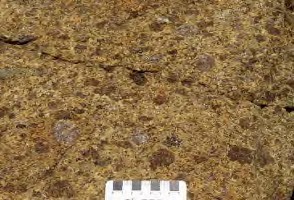
An example of a xenolith in one of the NRG rocks is shown in the figure below. Where the charnockite’s contacts with other rocks are exposed, it appears to be intrusive into these rocks.
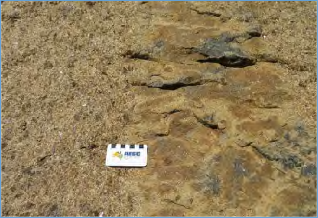
The Mawson Charnockite has been dated at around 954 Million years. Charnockites are distributed throughout the Precambrian shield areas of the southern continents (formerly making up the southern supercontinent of Gondwana which included most of the landmasses which make up today’s continents of the southern hemisphere, including Antarctica, South America, Africa, Madagascar, India, Arabia, Australia, New Guinea and New Zealand).
In mainland Australia, charnockites are found near Cape Leeuwin and Cape Naturaliste near Albany, Esperance Bay, Eyre Peninsula, and in the Musgrave Ranges.
Indigenous context
As the specimen originated on the continent of Antarctica, there is no known traditional association with Australia’s indigenous people.
About the NRG specimen
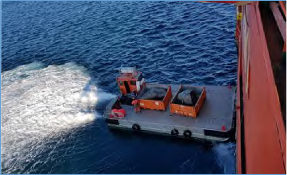
The specimens were loaded in crates onto a barge and moved out the research vessel Aurora Australia.
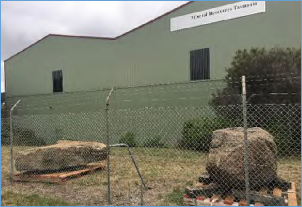
Following unloading on the docks at Hobart, the rocks were temporarily stored behind a secure fence at the Mornington core storage facility run by Mineral Resource Tasmania (MRT).
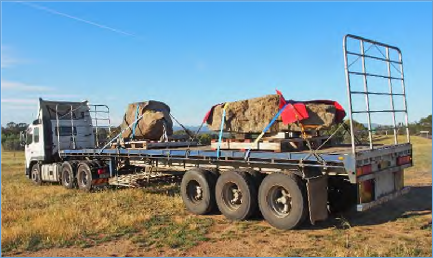
After funds were raised to cover the costs of the long haul from Hobart to the ACT, the rocks were placed on a truck and moved to the NRG’s rock storage site in Canberra.
DID YOU KNOW?
The unusual name ‘charnockite’ is derived from a polished and engraved tombstone made from dark greenish rock which was mined from St Thomas Mount near Chennai That rock was named charnockite to honor an employee of the English East India Company whose name was Job Charnock.
Acknowledgements
The NRG Steering Committee is very pleased to acknowledge the support of the Australian Antarctic Division for donating these rocks to the National Rock Garden, and for shipping them on the Aurora Australis from Antarctica to Hobart. We also thank the Minerals Council of Australia and Mr Warwick Wilmott for two donations which covered all of the transportation costs and the preparation of the specimens for display.
It is planned that a formal public promotion of the placement of the rocks at the NRG will be conducted in Canberra when they are moved to their final display position in 2022.
Want to know more?
About Douglas Mawson: https://en.wikipedia.org/wiki/Douglas_Mawson
Mawson Station information: https://www.antarctica.gov.au/about-antarctica/history/stations/mawson/
Touret, J.L.R. and Huizenga, J.M., 2012. Charnockite microstructures: From magmatic to metamorphic. Geoscience Frontiers, Vol 3, Issue 6, pages 745–753. https://doi.org/10.1016/j.gsf.2012.05.004